
Reviewed · LAO COOKING CLASSES
Luang Prabang: Evening Cooking Class & Local Baci Ceremony
The most memorable part of this Luang Prabang evening is not the cooking alone. You are welcomed into a local family setting for a Baci ceremony, a Lao blessing tied to health, homecoming, family events, and spiritual well-being. It gives the meal real cultural weight rather than making this just another recipe class.
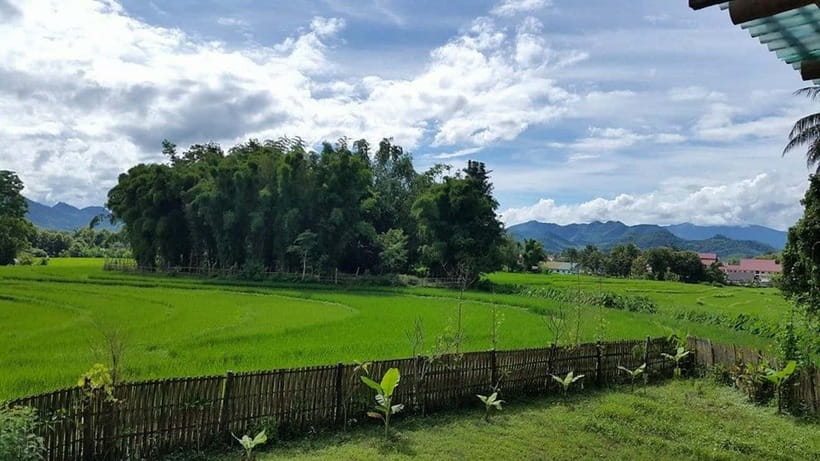
I like the small group limit of six, which leaves room for questions and hands-on cooking. I also like the setting: an open rustic pavilion modeled on a Lao house, with rice fields and mountain views around it. The main consideration is that cooking instruction may feel less structured if you want precise recipes or lots of dish choices.
Key points
- Local market first: Learn about herbs, produce, and daily food habits before cooking.
- Five Lao dishes: Prepare a full home-style dinner, with meat, fish, soup, salads, sticky rice, and dips varying by session.
- Baci with local elders: Join a meaningful blessing and receive ceremonial cotton strings tied around your wrists.
- Family-run setting: Cook in a simple outdoor kitchen using traditional charcoal burners.
- Music after dinner: Hear a Hmong musician play a traditional instrument, sometimes with a chance to try it.
- Practical format: Four hours, hotel pickup in Luang Prabang, English-speaking host, and a maximum of six people.
A four-hour evening that connects food and family
This experience begins at about 4 PM, when your driver collects you from your hotel lobby in Luang Prabang. The timing works well. You leave the town while there is still daylight, visit the market, and reach the cooking site in time for the late afternoon light over the rice fields.
The activity is designed as a chain of connected experiences. The market explains the ingredients. The cooking class shows how they become dinner. The Baci ceremony places the meal inside Lao family and spiritual life. Music then brings the evening to a relaxed close.
That combination is the real value. A standard cooking class can teach you how to pound herbs or prepare sticky rice, but this one also gives you a window into how food, family, belief, and hospitality fit together in Laos.
Start at a real local food market
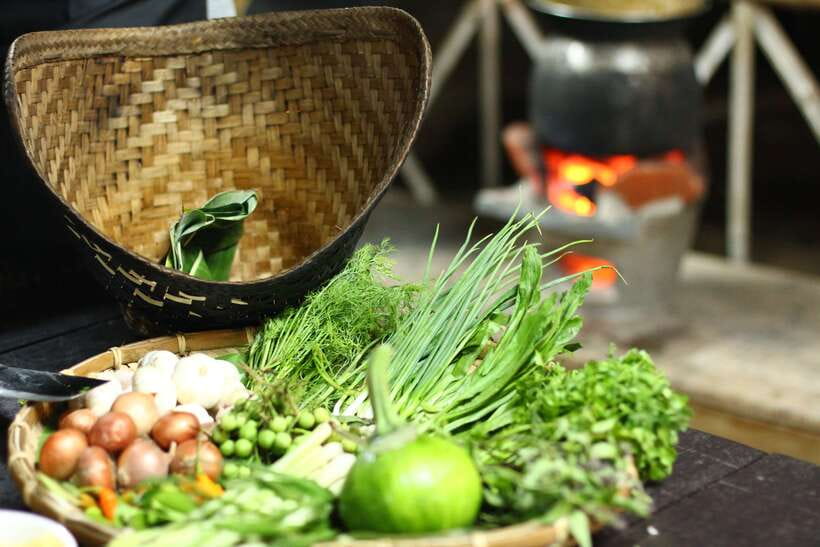
The first stop is a local food market, where your host introduces the fresh ingredients used in everyday Lao cooking. You might see herbs, vegetables, meat, fish, rice, and other items that are less familiar than the produce in a supermarket.
The market visit is not simply a shopping stop. Your guide explains how ingredients are used and how the market fits into ordinary local life. Guides such as Si and Somsay have been praised for taking time with these explanations, including the role of food in Lao homes and the daily rhythm of buying and preparing meals.
I like this part because it gives you useful context before you reach the kitchen. Instead of meeting a bowl of chopped herbs with no explanation, you have already seen the ingredients in their natural setting and can ask why a particular leaf, paste, or vegetable matters.
Allow some patience here. A local market is not arranged as a neat museum display, and the amount of information can vary with the group and the guide. One thing you may want to ask about is the wider use of market goods, not only the ingredients selected for your dinner.
More cooking classes in Luang Prabang
- Luang Prabang: Bamboo Weaving Workshop & Cooking Class
★ 5.0 · 96 reviews - Luang Prabang: Cooking Class at the Former Royal Palace
★ 4.9 · 51 reviews - Day-time Bamboo weaving & Cooking Classes join-in
★ 5.0 · 38 reviews
Cook five dishes in a traditional-style pavilion
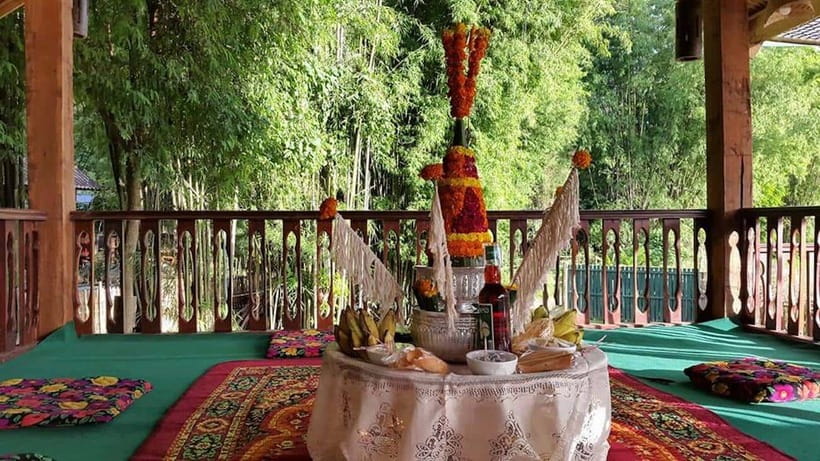
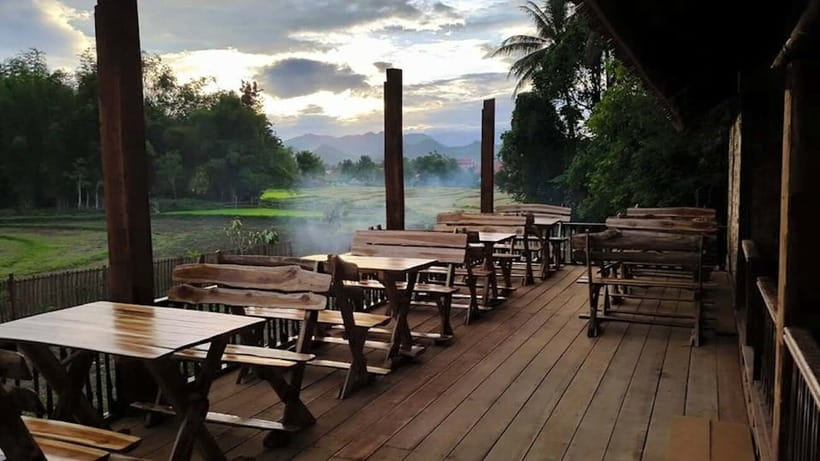
After the market, you continue to the cooking site in a small village setting outside the center of Luang Prabang. The cooking takes place in a rustic pavilion modeled on a traditional Lao house, with open sides and views across rice fields toward the surrounding mountains.
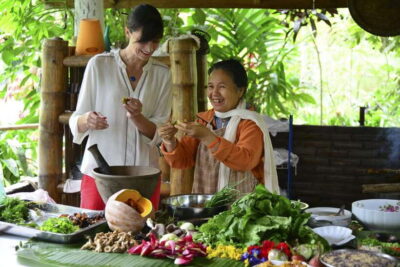
This is a simple working kitchen, not a polished culinary studio. One detailed account describes charcoal burners and a basic outdoor cooking area. That simplicity is part of the appeal, since you see how a home-style Lao meal can be made with ordinary tools rather than specialist equipment.
You help prepare five typical dishes using the ingredients selected at the market. The exact menu can vary, but the meal may include a soup, meat, fish, sticky rice, salads, and dips such as tomato or eggplant. Laap and other familiar Lao flavors may also feature, depending on the session.
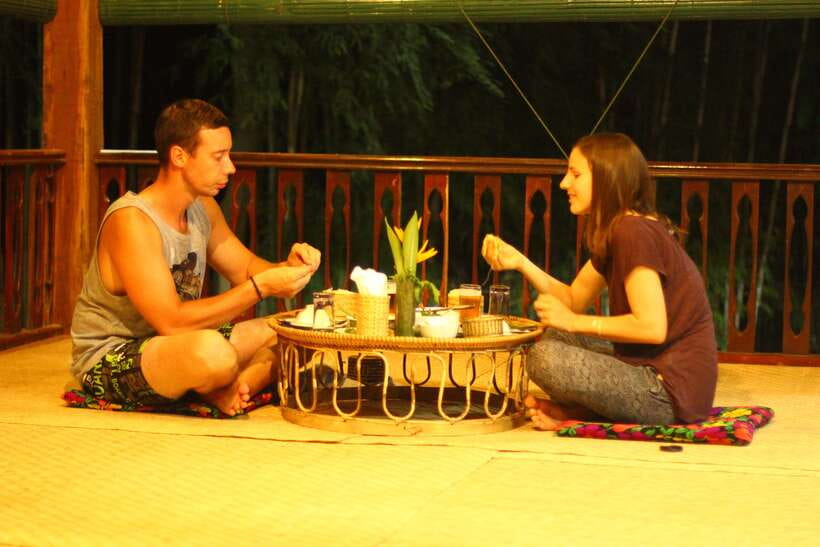
The food is cooked and eaten in the traditional Lao style, with several dishes shared at the table. This is a good format for trying different flavors. You can compare sour, salty, herbal, smoky, and spicy elements in one meal instead of ordering a single dish in a restaurant.
Vegetarians can take part. One session was adapted successfully for vegetarian diners, so tell the operator about your needs when booking. Still, the supplied information does not promise a fixed vegetarian menu, so you should confirm your requirements in advance.
How hands-on is the cooking?

You should expect to participate, not just watch a demonstration. Guests have described preparing ingredients, cooking over charcoal, making dips, handling sticky rice, and helping with several parts of the meal.
The small group format helps. With no more than six participants, you are more likely to get a task and receive personal help than in a large class. When one person booked during the quiet season, the instruction was especially hands-on and included doing nearly every step.
There is one fair limitation. If you want a highly technical cooking lesson with exact measurements, printed recipes, and a choice of several menus, this may feel informal. The emphasis is on shared home cooking and cultural exchange. One useful improvement would be to provide written recipes, since you may want to recreate the meal at home.
You also should not expect complete control over the menu. The host selects the dishes and ingredients, and the cooking is built around what is fresh and practical for the group.
The Baci ceremony is the heart of the evening
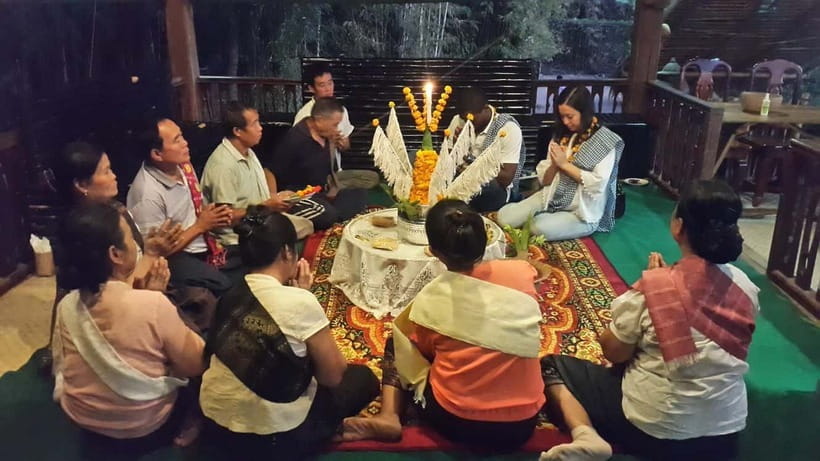
The Baci ceremony gives this activity its strongest sense of place. In Lao tradition, a Baci can mark a marriage, birth, homecoming, recovery from illness, a mother’s recovery after childbirth, or the arrival of monks at a temple. It may take place at any time of year, with late afternoon and the period before sunset considered suitable.
At the cooking site, local elders lead the ceremony while your English-speaking host explains what is happening. You may hear chanting and singing, receive a blessing, and have cotton strings tied around your wrists. The strings represent good wishes and are normally kept on for a period of time.
The ceremony is intimate and personal. You are not watching a stage performance. You are being invited to sit with local people and take part in a custom that still has meaning in family life. That distinction matters, especially if you are careful about cultural activities that feel staged only for visitors.
You should approach this section with respect. Wear clothing that covers your shoulders and knees, and follow the host’s instructions about sitting, gestures, and participation. Some people may find the floor seating difficult, especially if they have stiff knees or limited mobility. The activity is not suitable for wheelchair users or people with mobility impairments.
The Baci may also include small snacks or local refreshments, but alcoholic drinks are not included in the price. Do not book this as a drinking evening. The point is the blessing and the welcome.
A few more trips around Luang Prabang worth a look
- Luang Prabang: Afternoon Kuang Si Waterfalls & Sunset Cruise
★ 4.6 · 158 reviews - Luang Prabang Evening Food Tour by Tuk-Tuk
★ 4.5 · 68 reviews - Luang Prabang: Mekong Sunset Cruise & Lao Tasting Dinner
★ 4.3 · 27 reviews - From Chiang Rai : 2 Day 1 Night Slow Boat to Luang Prabang
★ 4.0 · 26 reviews
Music beside the rice fields
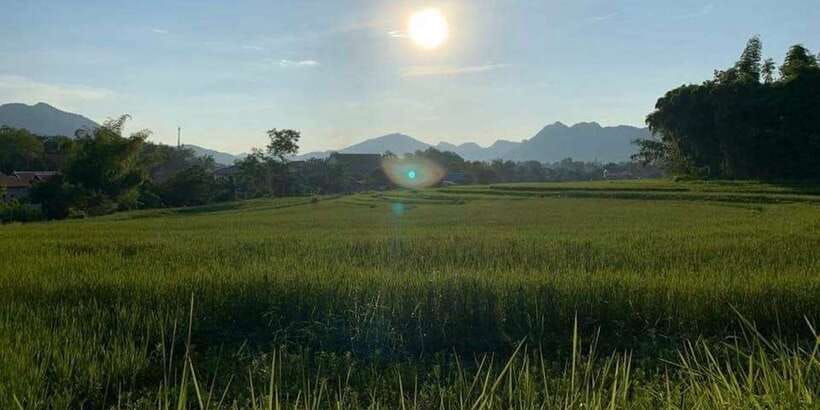
After dinner, local musicians perform traditional music. A Hmong musician may play a khene, a traditional Lao wind instrument, sometimes accompanied by singing, movement, or a short dance.
This final performance is modest and direct. You sit after the meal, look out over the fields, and listen to an instrument connected with local culture. In some sessions, you can try playing it yourself. That small invitation makes the music feel less like a show and more like a shared moment.
The open pavilion is especially pleasant toward sunset. The views are a major part of the setting, although weather and seasonal conditions will affect what you see. The rice fields are not just decoration: they help place the food and the family gathering within the rural setting that supports Lao daily life.
What the $51 price includes
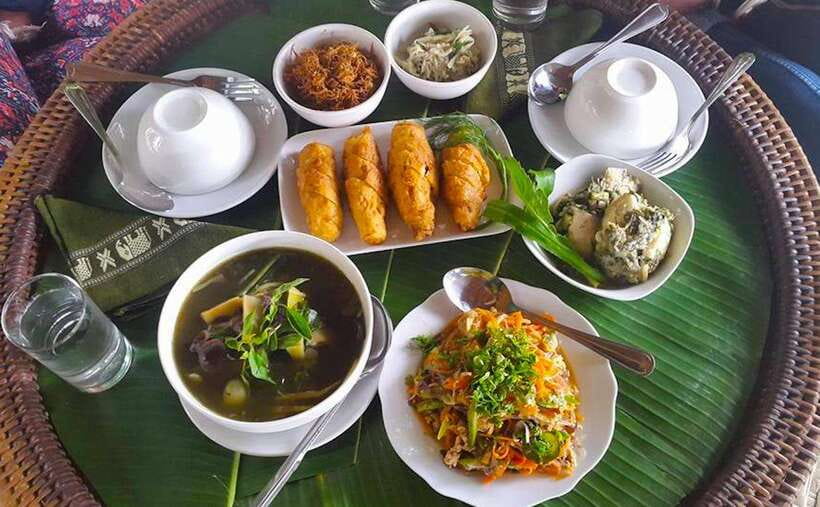
At $51 per person, the price is reasonable if you want more than a meal or a short cooking lesson. You receive hotel pickup and drop-off in Luang Prabang, an English-speaking host, the market visit, cooking instruction, dinner, the Baci ceremony, and the music performance.
The transport matters because the cooking site is outside the town center. You do not need to arrange a separate taxi or figure out how to return after dinner. The four-hour schedule also gives you several activities without taking an entire day away from Luang Prabang’s temples and riverfront.
The value is strongest for people who would otherwise pay separately for a restaurant meal, a cooking class, and a cultural visit. Here, the activities are joined together and supported by a local family.
The price is less attractive if you only want cooking technique. You can find cheaper meals in Luang Prabang, and a dedicated culinary class may offer more detailed recipes. This experience is worth the extra cost because of the setting, family contact, market visit, and Baci ceremony.
Who will enjoy this most?
This is a strong choice for food lovers, first-time visitors to Laos, couples, families with older children, and anyone who wants a cultural activity that feels personal rather than crowded.
It also suits people who like variety. In four hours, you visit a market, travel to a village setting, cook, eat, attend a ceremony, and hear music. The pace is full but not built around rushing from one attraction to another.
You should think twice if you dislike shared meals, informal outdoor kitchens, traditional ceremonies, or sitting in a position that may be uncomfortable. It is also not suitable for pregnant women, wheelchair users, or people with mobility impairments.
The family-friendly label is fair, but children should be comfortable with food preparation and respectful participation in the Baci. Parents should also note that the experience takes place in an open rural setting, not a controlled indoor classroom.
Practical advice before you go
Wear comfortable clothes and shoes. Most important, cover your shoulders and knees for the ceremony. Loose clothing is useful for cooking and sitting, while closed or sturdy shoes are sensible around an outdoor kitchen.
Arrive in your hotel lobby about five minutes before the scheduled pickup. Hotel pickup is available from hotels in Luang Prabang city. The tour operates in English, and the group is limited to six people.
Tell the operator about dietary needs before the activity. Vegetarian cooking is possible, but the menu is based on the day’s ingredients and the family’s planned meal. If you want to repeat the dishes at home, ask whether the host can share recipe notes before you leave.
The activity includes food but not alcoholic drinks. You should also avoid bringing outside food and drinks, since they are not allowed during the activity.
Free cancellation is available up to 24 hours before the start time, and you can reserve while paying later. That is useful if your Luang Prabang plans depend on weather or transport connections.
Should you book the Luang Prabang Baci cooking evening?
I would book this if you want a warm, personal introduction to Lao food and family traditions. The strongest reasons are the small group, the local market, the home-style charcoal cooking, and the Baci ceremony with elders.
I would not choose it solely for advanced cooking instruction. The class is informal, the menu is set by the host, and recipe information may be limited. But if you value the story behind the food as much as the food itself, the $51 cost is justified.
The Baci is the deciding factor. A cooking class can be replaced by a restaurant meal or another lesson. Sitting with a local family, receiving a blessing, eating what you helped prepare, and hearing traditional music beside the rice fields is much harder to duplicate on your own.
FAQ
How long does the activity last?
The experience lasts four hours, beginning with hotel pickup at about 4 PM. You visit the market, cook and eat dinner, attend the Baci ceremony, and hear traditional music before returning to your hotel.
Is hotel pickup included?
Yes. Pickup and drop-off are included for hotels in Luang Prabang city. You should wait in the hotel lobby five minutes before the scheduled pickup time.
How many people are in the group?
The activity is limited to six participants, making it a small-group experience.
What food will I cook?
You will help prepare five typical Lao dishes. The meal can include items such as soup, meat, fish, sticky rice, salads, and tomato or eggplant dips. The exact dishes may vary.
Can vegetarians join?
Yes, the cooking class can accommodate vegetarians. You should provide your dietary information when booking so the meal can be planned properly.
What should I wear for the Baci ceremony?
Wear clothing that covers your shoulders and knees. Comfortable clothing and shoes are recommended for the market visit and cooking session.
Just added in Luang Prabang
- Luang Prabang: Pottery Workshop & Wat Chomphet cycling Tour★ 4.6 · 5 reviews
- Luang Prabang Early Morning Alms Giving and Wet Market★ 4.5 · 5 reviews
- Luang Prabang: Countryside Mountain Bike Tour with Lunch★ 3.6 · 7 reviews
- 3 Days The Plain of Jars and Xieng Khouan (Depart from Luang Prabang)★ 5.0 · 3 reviews
- Luang Prabang Local Market and Morning Food Tour with Drinks★ 5.0 · 6 reviews
- Luang Prabang: Nong Khiaw 3-Day Trekking & camping, Homstay★ 5.0 · 9 reviews
- Luang Prabang: Weaving Workshop Half-Day Experience★ 5.0 · 9 reviews
- Laos Railway: Train Tickets Easily – Skip the Lines – No worries★ 5.0 · 9 reviews
Lao Cooking Classes, compared.
Day-time Bamboo weaving & Cooking Classes join-in
Read our review →
Evening Bamboo weaving & Cooking classes join-in
Read our review →
Tribal Cooking Class in Luang Prabang Forest and visit
Read our review →
Traditional Market Tour and Private Laotian Cooking Class with a Local
Read our review →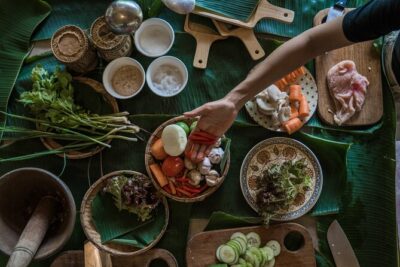
Browse the lists this tour appears in